What Is a Proof Roll?
A proof roll test is a field method for evaluating subgrade stability. A fully loaded dump truck is driven across the prepared subgrade while an inspector observes the surface for signs of deformation — rutting, pumping, deflection, or rolling.
The typical pass/fail threshold is 1 inch of deformation or less. If the subgrade deflects more than that under the loaded truck, construction cannot proceed until the subgrade is stabilized. Failing a proof roll means delays, change orders, and cost overruns — which is why getting ahead of it with proper testing and design matters.
Visual Subgrade Assessment
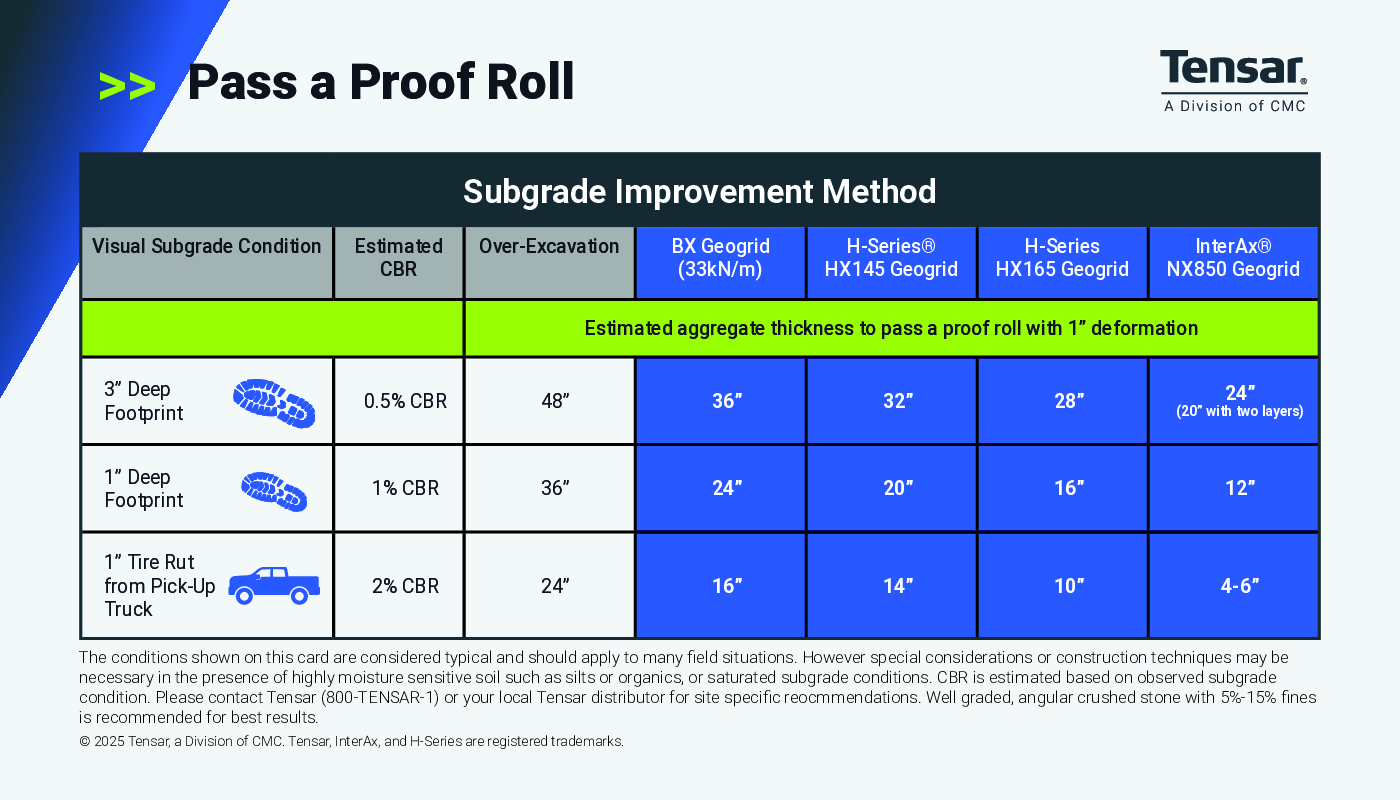
Before running a DCP test, you can estimate your subgrade CBR by looking at the ground. These visual indicators correlate to approximate CBR values:
| Visual Condition | Estimated CBR | Severity |
|---|---|---|
| 3" deep footprint | 0.5% CBR | Very Soft |
| 1" deep footprint | 1% CBR | Soft |
| 1" tire rut from pickup truck | 2% CBR | Moderate |
Aggregate Thickness to Pass a Proof Roll
The chart below shows the estimated aggregate thickness needed to pass a proof roll with 1" or less deformation, based on subgrade CBR and geogrid product. Well-graded, angular crushed stone with 5%-15% fines is recommended for best results.
| Subgrade | CBR | Over-Excavation (no geogrid) | BX Geogrid (33kN/m) | H-Series HX145 | H-Series HX165 | InterAx NX850 |
|---|---|---|---|---|---|---|
| 3" footprint | 0.5% | 48" | 36" | 32" | 28" | 24" (20" with 2 layers) |
| 1" footprint | 1% | 36" | 24" | 20" | 16" | 12" |
| 1" tire rut | 2% | 24" | 16" | 14" | 10" | 4-6" |
Source: Tensar 2025 Subgrade Pocket Card. These conditions are considered typical. Special considerations may be necessary for highly moisture-sensitive soils (silts, organics) or saturated subgrade conditions. Contact us for site-specific recommendations.
Cost Savings Example
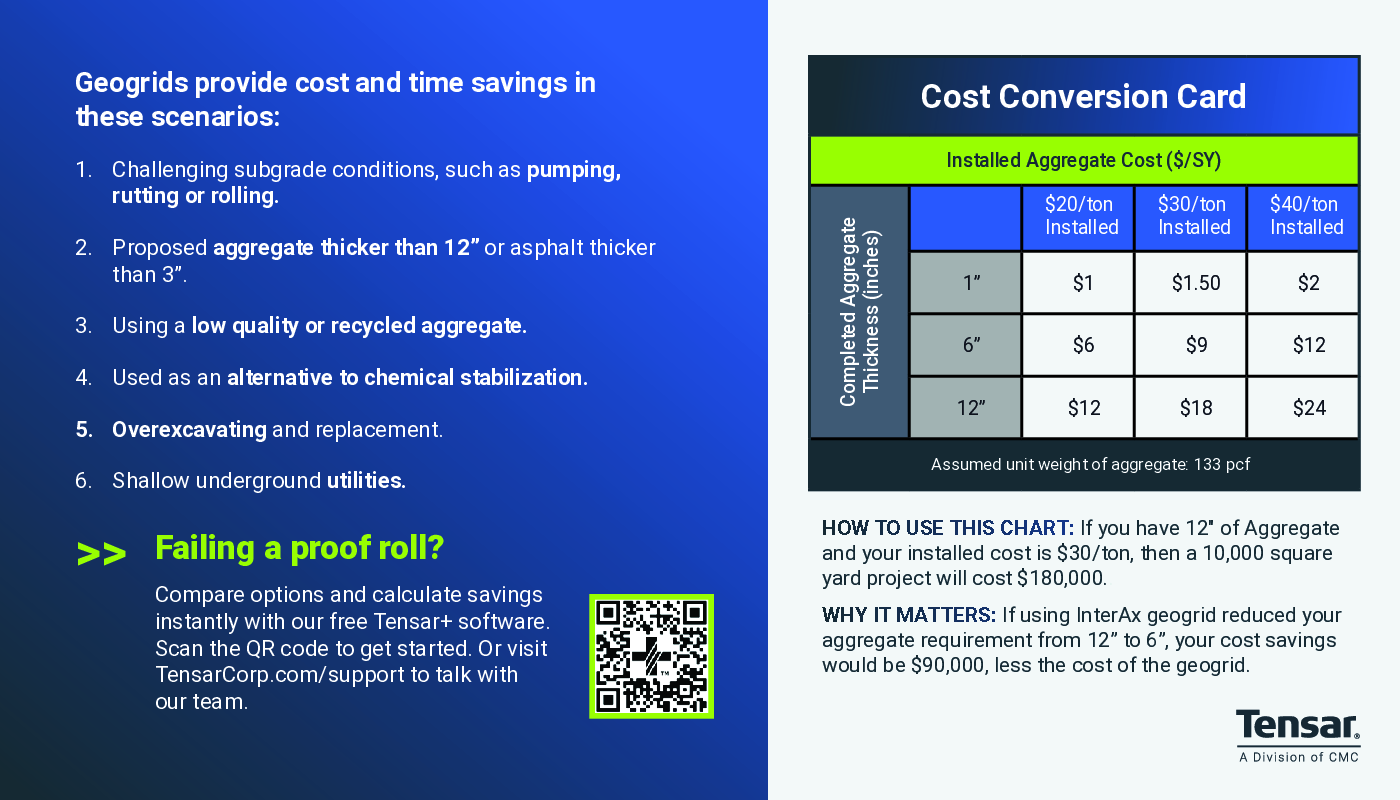
The aggregate is often the most expensive part of subgrade stabilization. Reducing the required thickness with geogrid directly reduces your project cost.
Example: 10,000 Square Yard Project at $30/ton Installed
| Aggregate Thickness | Cost per SY | Project Cost |
|---|---|---|
| 12" (no geogrid) | $18.00 | $180,000 |
| 6" (with InterAx geogrid) | $9.00 | $90,000 |
Savings: $90,000 less the cost of geogrid. Assumed aggregate unit weight: 133 pcf.
Try our Cost Savings Calculator with your own numbers →When to Consider Geogrid
- Challenging subgrade conditions — pumping, rutting, or rolling
- Proposed aggregate thicker than 12" or asphalt thicker than 3"
- Using low-quality or recycled aggregate
- As an alternative to chemical stabilization
- Over-excavation and replacement scenarios
- Shallow underground utilities that prevent deep excavation
- Failing a proof roll
Aggregate Recommendations
For best results with geogrid, use well-graded, angular crushed stone with 5%-15% fines. The angular particles interlock with the geogrid apertures more effectively than rounded aggregate, creating a stronger mechanically stabilized layer. Avoid using clean stone (no fines) or excessive fines (over 15%) as both reduce the confinement effect.
Need Help With a Proof Roll?
We perform on-site DCP testing and run your results through Tensar Plus to determine the right geogrid and aggregate thickness for your specific site. No guesswork — engineered solutions.